Our CEO Melissa Davis explains how the key takeaways from the latest LinkedIn algorithm report are similar to building your network at the big legal conferences.
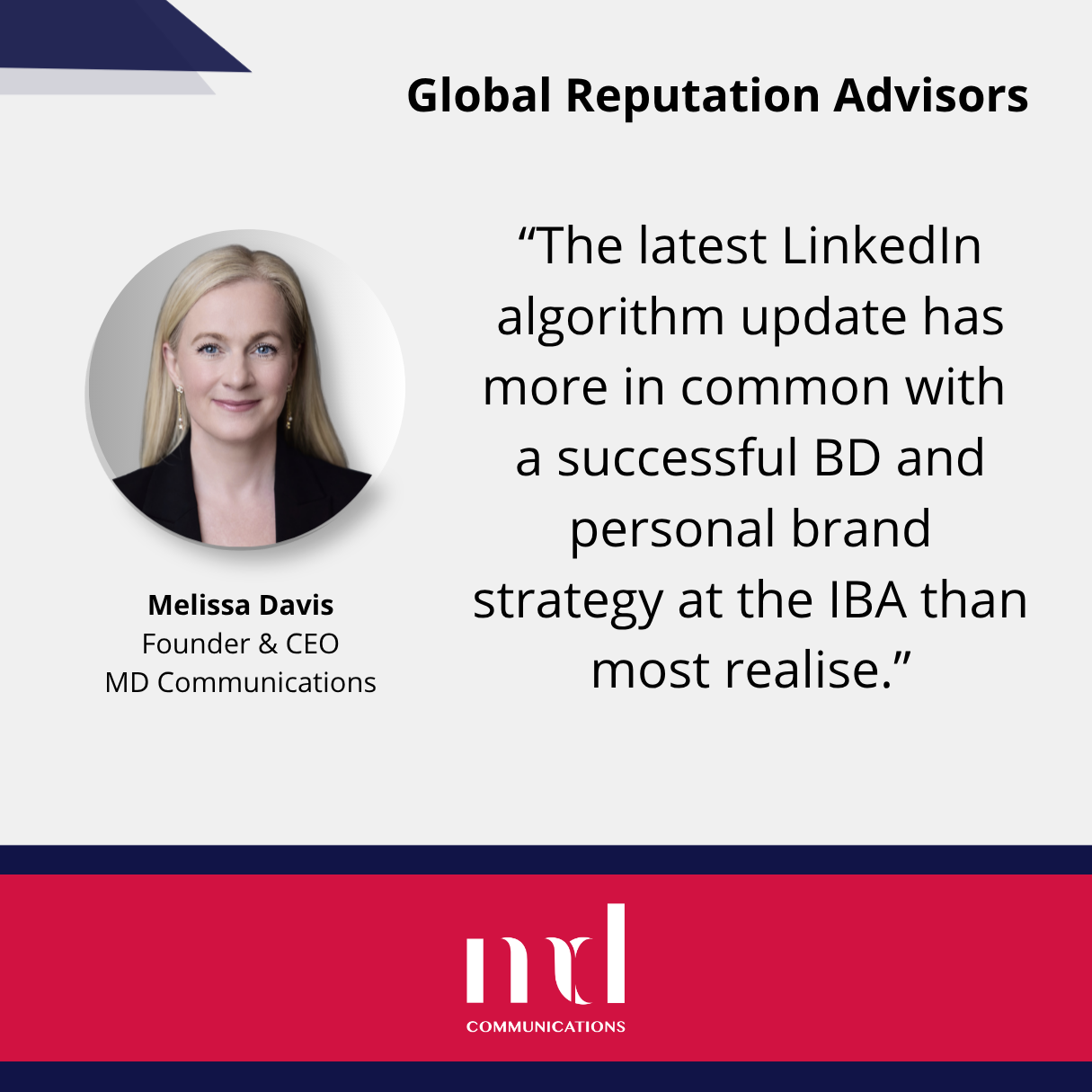
The latest LinkedIn algorithm update has more in common with a successful business development and personal brand strategy at the IBA or INTA than most realise.
You wouldn’t walk into a conference with 10,000 delegates and expect to build meaningful relationships with everyone in the room. Those who get real value from these events are rarely the ones racing between back-to-back coffee meetings collecting business cards they’ll never look at again. They are the people who find their groups, their committees, their communities and the conversations they genuinely want to be part of. They go deeper, not wider. They spend time with the same people repeatedly, allowing relationships, trust and opportunities to develop naturally over time.
That is personal brand building in practice and LinkedIn is now rewarding exactly the same behaviour.
So why do we need to stop trying to appeal to everyone and start becoming known for something specific?
Here’s the uncomfortable truth: if your LinkedIn performance has dropped, it’s not bad luck. It’s the platform changing faster than most people are willing to adapt.
In Richard van der Blom’s latest algorithm report, the data shows reach has fallen by as much as 65%. That sounds alarming, but it’s only half the story. Engagement is actually increasing. Fewer people may see your content, but the right people are far more likely to interact with it.
That’s because LinkedIn has fundamentally shifted from a relationship graph (who you know) to an interest graph (what you’re known for).
In many ways, this mirrors how successful networking works at large international conferences. The most effective people are not trying to meet everybody. They become associated with particular sectors, conversations, committees and themes. Over time, people know what they stand for, where they add value and why they are worth introducing into opportunities. That is how strong personal brands are built, both online and in person.
Your content is no longer confined to your network. More than a third of what people see on LinkedIn now comes from complete strangers. The platform is actively introducing your content to people outside your immediate circle, but only if it understands your expertise clearly enough to know who should see it.
That’s the opportunity. But there’s a trade-off: vagueness is punished.
For the legal sector, this is actually good news. The clearer your niche, the easier it is for LinkedIn to categorise you and place your content in front of the right audience. Generalists blend into the noise. Specialists build recognition, trust and authority.
So what actually works now?
Align your profile
First, your profile and your content need to align. LinkedIn is constantly building what you could call a “topic fingerprint” – a picture of what you talk about, comment on and engage with over time. Before your post is even shown to people, the platform is assessing whether it trusts you on that topic.
Half your LinkedIn reach is determined before you even post. The data shows a 50.1% influence from your profile and topic consistency, 29.5% from the post itself, and 20.5% from external factors.
If LinkedIn can’t categorise you, it won’t distribute your content. To fix this, audit your last 20 posts and aim for a 70/20/10 split between core themes, adjacent topics and personal content over the next 30 days.
Consistency builds credibility. Not just in what you post, but in how you show up across the platform. Your headline, About section and Featured posts should all reinforce the same themes.
And this takes us back to conference strategy. The lawyers who are remembered at global conferences are usually known for something specific. You remember the investigations lawyer who always contributes thoughtfully to sanctions discussions, or the employment partner consistently involved in ESG and workplace culture debates. You don’t remember the person who tried to speak to everybody but never really said anything memorable.
Engage daily
That leads to the second shift: daily engagement matters more than most people realise. You don’t need hours. Fifteen minutes is enough – if you’re deliberate. Engage with high-quality content in your space. Add comments that actually contribute something. Ignore or mute what doesn’t.
This isn’t just about being visible. Every interaction sharpens your topic signal. Over time, it improves both what you see in your feed and how your own content is distributed.
Content themes
Then there’s your content itself. The strongest performers are those who stick to two or three clear themes. That doesn’t mean you can’t share personal stories or opinions – it just means they need to connect back to those core areas. Think of your themes as anchors. Everything else should orbit around them.
Do this well and something important happens: you start to build topic authority.
LinkedIn is effectively asking three questions:
– Are you consistent in what you talk about?
– Do people engage meaningfully with your content in that space?
– Can the platform easily understand and categorise what you’re saying?
If the answer to all three is yes, your content travels further – especially beyond your immediate network.
Posting frequently isn’t enough anymore. If anything, off-topic posting does more harm than good. If your content jumps between unrelated themes, the algorithm struggles to categorise you – and when that happens, distribution suffers.
Follow deliberately
Another area people get wrong is who they follow. Most users only ever add – more connections, more creators, more noise. Very few take anything away.
But every interaction, even passive ones, feeds your topic fingerprint. If your feed is cluttered with irrelevant content, your signal becomes diluted. As a simple fix, every couple of weeks, spend five minutes unfollowing or muting anything that no longer aligns with your focus. It’s a small habit that makes a noticeable difference.
Commenting: a key part of your strategy
Now, on to commenting – which is massively undervalued.
Commenting within your niche is just as powerful as posting. In fact, it’s often faster for building visibility. Posts designed to spark replies tend to travel further than those designed for passive likes.
A good comment isn’t “great post.” It’s a piece of micro-content. It has a point of view, maybe a quick example, counterpoint, or your own experience, and invites a response. Done well, it builds both your reputation and your reach.
In terms of cadence, the current sweet spot is posting two to three times a week, and commenting five times daily. If you’re spending all your time publishing and none engaging, you’re leaving results on the table.
This might feel too much for busy lawyers, so we recommend two to three comments a day and one post a week.
Hidden accelerators
There are also a couple of underused levers worth paying attention to.
Saves and reposts are disproportionately powerful signals – and most people don’t optimise for them. If you want saves, create something genuinely useful: a framework, a checklist, a step-by-step guide. The kind of content people come back to. Just be aware that high-save content often generates fewer comments. It’s consumed quietly, not publicly.
Another key metric now is completion rate – how much of your content people actually finish. This matters particularly for carousels. If people drop off after the first few slides, LinkedIn notices – and distribution takes a hit.
Nurturing your post
Finally – and this is where most people fall short – what you do after posting is just as important as the post itself.
The “golden window” has expanded. It’s no longer just the first hour; it’s now up to four. Engaging during that time – replying to comments quickly and thoughtfully – can multiply your reach significantly. Ignore it, and you cap your own performance. Then keep checking in to reply to comments later on – each reply boosts your post a little more.
Final thoughts
The lawyers with the strongest personal brands, both online and offline, are rarely the loudest people in the room. They are the clearest.
They understand that business development is not about collecting the highest number of contacts, attending the most receptions or posting on every trending topic. It is about building recognition around a small number of themes and showing up consistently enough that people begin to associate you with expertise, insight and value in those areas.
The same principle applies at conferences like the IBA, INTA or any major industry event. The best networkers are not butterflies trying to work the entire room. They are strategic. They invest repeatedly in the same communities, committees and conversations where relationships deepen over time. That is where trust is built, and trust, not visibility alone, is what ultimately drives referrals, opportunities and long-term growth.
LinkedIn is now rewarding exactly that behaviour.
So the real question for lawyers is no longer: “How do I reach more people?”
It is: “What do I want to be known for and am I showing up consistently enough for people and platforms to believe it?”
We offer LinkedIn training for groups and individuals – get in touch if you’re interested.